

Decision Rights, Judgment Infrastructure, and the Renewal of Expertise
/ The Human Operating Model for the Agentic Enterprise



Agentic AI is moving from individual assistance into the operating fabric of the enterprise. It can coordinate across functions, select the next step in a workflow, use tools, engage people and systems, and continue toward an outcome. This expands the value horizon from personal productivity to end-to-end work configuration.
It also elevates a deeper leadership question: as intelligent systems take on more execution and autonomy, how will the organization strengthen the human judgment, ownership and expertise on which future performance depends?
The answer lies in the Human Operating Model, namely how an enterprise designs work, roles, decision rights, incentives, capabilities and learning around accountable outcomes. As AI assumes greater autonomy, the decisive constraint becomes the enterprise’s ability to redesign work, allocate authority, coordinate across functions and renew human expertise. The Human Operating Model bridges AI capability and enterprise transformation outcomes.
/ The Hidden Work inside Work
Every role combines visible output with less visible capability-building. A junior consultant produces analysis for a client engagement. The visible output is a model or presentation deck. The enduring value comes from repeated exposure to ambiguity, challenge and feedback: the experiences that teach the consultant to distinguish a compelling argument from a merely plausible one in unpredictable situations.
We need to shift the discussion from the impact of AI on entire roles to its impact on the portfolio of tasks within each role. Some tasks can be delegated through AI-enabled automation, others enhanced through AI-enabled augmentation, while others remain primarily human because they depend on physical presence, judgment, leadership or interpersonal interaction. The question “Will AI take my job?” therefore frames the issue too narrowly. In most cases, roles are more likely to be substantially transformed as their underlying mix of tasks changes.
Every enterprise contains work that delivers today’s output while developing tomorrow’s expertise. As AI absorbs tasks that also serve learning, that capability-building function requires deliberate redesign going forward.
As routine production moves to human–AI orchestration, leaders must redesign future-expert pathways around customer exposure, exception handling, deliberate practice, error diagnosis and progressively greater responsibility. This is not simply a headcount question; it is about preserving the learning trajectory through which expertise develops.
This interpretation aligns with joint research from the International Labor Organization and Poland’s National Research Institute [ILO- NASK], which positions task transformation as the central workforce dynamic. One in four jobs is potentially exposed to generative AI, while transformation of the tasks within those jobs appears more likely than complete replacement. For enterprises, the implication extends beyond job counts to a more fundamental question: how to preserve the development and continuity of expertise as the composition of work changes.
Leadership implications: The leadership task is therefore larger than preserving existing entry-level jobs or reducing headcounts. Winning organizations preserve the path to judgment by identifying the experiences, i.e., customer exposure, exception handling, deliberate practice, error diagnosis, that create expertise and placing them explicitly into redesigned roles, progression models and performance expectations.
/ When AI Crosses the Organization
Agentic AI changes how work moves across an enterprise. An industrial maintenance agent can connect sensor signals, maintenance history, parts availability, production schedules and customer commitments. The workflows quickly crosses engineering, operations, supply chain and commercial functions, creating an opportunity to move from fragmented tasks to end-to-end work configuration. It also increases the importance of human authority across organizational boundaries: an accountable owner must reconcile priorities across the value stream.
A field experiment involving 791 professionals at Procter & Gamble found that generative AI helped bridge technical and commercial perspectives in a bounded product-innovation task. The implication is promising: AI can make knowledge more fluid across functions. The Human Operating Model determines who owns the outcome, makes consequential decisions and reconciles competing priorities.
Leadership implications: Functions remain vital homes of expertise. As AI-enabled end-to-end work configuration crosses functions, assign an accountable outcome owner whose authority travels across the same boundaries. Cross-functional agents require cross-functional human outcome ownership.
/ Expanding the AI Value Case
Efficiency and cost improvement remain important parts of the AI opportunity. The enterprise value case also includes growth, quality, customer impact, risk performance, responsiveness, redeployed capacity and the renewal of organizational capability.
For a large insurer, automating routine claims can reduce cycle times and handling costs. It can also enable claims professionals to focus on complex and high-severity cases, strengthen fraud detection, and apply their experience to underwriting and pricing. Capturing this value requires clear decisions about workforce redeployment, target service levels, process ownership and capability development.
This creates a credible workforce proposition. Leadership must make explicit which work will disappear or evolve, what responsibilities will emerge, where capacity will move and how people will participate in redesign.
Leadership Implication: Build the AI business case around measurable improvements in productivity, growth, quality, risk, customer service and capability-building. For each expected benefit, define an accountable owner, a target measure and how time or cost savings will be reinvested. Involve employees in redesigning the work and provide training for the roles and responsibilities that emerge.
/ Judgment Becomes Enterprise Infrastructure
As AI takes on more execution, human contribution concentrates where context, trade-offs and consequences matter most: defining objectives, resolving exceptions, intervening when conditions change and accepting accountability for outcomes. A review becomes effective human control only when the reviewer has the competence, context, time and authority to reach an independent conclusion.
Consider a credit decision in a large bank. AI can evaluate financial information, apply lending criteria, identify risk indicators and recommend a course of action. A senior credit officer must determine whether the recommendation reflects the customer’s circumstances, current market conditions and the bank’s risk appetite. The officer may challenge its assumptions, request further evidence, approve an exception or escalate the decision and remains accountable for that judgment.
Human–AI performance is therefore a design outcome. A 2024 meta-analysis covering 106 experiments found that results varied by task and by how responsibilities were allocated. A 2025 study involving 319 knowledge workers found that participants reported shifting critical-thinking effort from producing outputs towards verification, integration and oversight when using generative AI. Together, these findings sharpen the leadership question: which activities should AI execute, where should human judgment prevail and where should both contribute? They also reinforce validation, challenge and independent assessment as core workforce capabilities.
At bluegain, we use judgment debt to describe the risk that speed and throughput improve faster than independent human judgment is renewed. As routine cases move to AI, learning opportunities can decline, reviews can become procedural, and intervention capability can become concentrated among fewer experts. The organization’s ability to question, override and recover then weakens over time.
Organizations can manage judgment debt by preserving independent review, rotating employees through complex exceptions, measuring intervention quality and rehearsing recovery through realistic scenarios.
Leadership implications: Treat judgment as a governed enterprise capability with clear ownership, decision rights, competence requirements and measures of effectiveness. Monitor both AI-enabled performance and the organization’s ability to challenge, intervene and recover. Scale autonomous execution in line with the enterprise’s demonstrated capacity to exercise these responsibilities.
/ Designing the Human Operating Model for AI
The opportunity of agentic AI extends beyond automating today’s work. It gives leaders the opportunity to rethink how work, authority and expertise come together around enterprise outcomes.
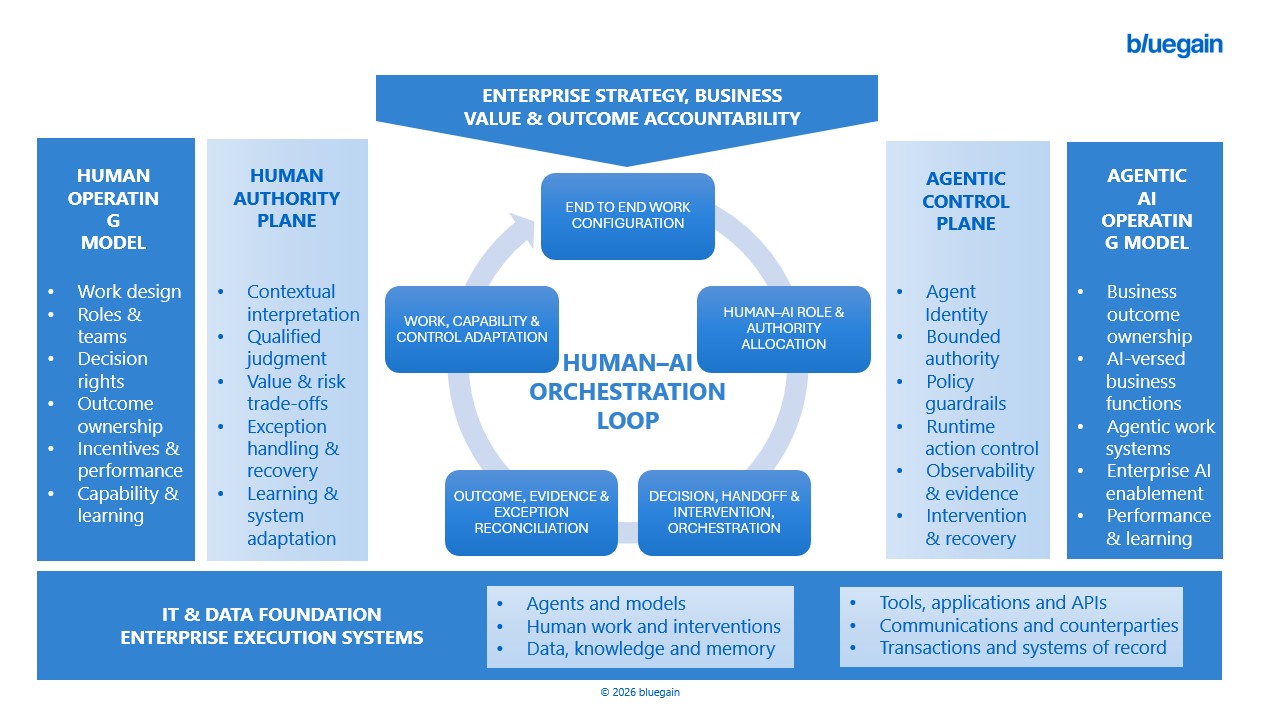 Figure 1. bluegain’s Enterprise Human–AI Orchestration Model shows how human and agentic systems work together to translate enterprise strategy into accountable execution, continuous adaptation and business outcomes. Source: bluegain analysis, 2026.
- Design around outcomes, not existing work.
Start with the outcome the enterprise wants to create, then redesign the work around the combined strengths of people and AI. The ambition is not to automate the organization we have, but to shape the organization AI now makes possible. - Recompose roles around human and AI strengths.
As tasks move between automation, augmentation and human execution, roles become dynamic portfolios of contribution. The leadership opportunity is to concentrate human capacity where context, judgment, relationships and accountability create the greatest value. - Let decision rights evolve with AI autonomy.
Greater AI autonomy creates an opportunity to make organizational authority more deliberate. Define where AI can act, where people decide and where escalation belongs, so that faster execution is accompanied by equally clear accountability. - Match end-to-end work with end-to-end ownership.
AI can connect work across boundaries that organizational structures historically separated. Preserve deep functional expertise while giving accountable leaders the authority to orchestrate decisions and outcomes across the full value stream. - Turn judgment into an organizational capability.
As AI expands execution capacity, human judgment becomes more—not less—strategic. Build the context, competence and authority to challenge, intervene and recover into the operating model, so that greater autonomy strengthens rather than dilutes organizational control. - Design today’s work to create tomorrow’s experts.
Every redesign of work also redesigns how expertise is formed. Preserve the experiences that build judgment—exposure, exceptions, feedback and progressively greater responsibility—so that AI accelerates performance while the organization continues to deepen its human capability. - Convert the AI dividend into enterprise capacity.
The value released by AI creates strategic room to strengthen what comes next: better customer outcomes, innovation, growth, resilience and capability. Make that reinvestment a leadership choice, turning productivity gains into the capacity for the next wave of transformation.Together, these principles shift the Human Operating Model from a response to AI into an engine of enterprise renewal. The opportunity is not simply to accommodate greater machine capability, but to use it to create clearer ownership, stronger judgment, more fluid organizations and continuously renewed expertise.
As AI advances, the organizations that create enduring advantage will be those that evolve human capability and machine capability together.
/ About the Author
- Arjun Aditya is a Digital Marketing Associate at bluegain, where he focuses on digital branding and communications. Before joining bluegain, Arjun worked at Adidas AG on a global transformation project, leading user-centric change initiatives that impacted over 1,000 employees. He also gained experience at Pollup Data Services and A2A Digital Transformation Consulting. Arjun holds a Master’s degree in Digital Business Innovation from Politecnico di Milano.
/ DOWNLOAD WHITEPAPER
Empowering you with knowledge is our priority. Explore our collection of well-thought-out whitepapers available for download. Should you have any questions or wish to explore further, our team is here to assist you.
download

 back to Article
Further Insights